

Showing posts with label All About Mazi. Show all posts

Thursday, December 9, 2010

Another Black Boy, Another Senseless Murder—When Will It Stop?

Pace University Football Player Danroy Henry, Jr.

By NICK CHILES

When will it stop? Another innocent black man killed by the cops. This time it was in Westchester County, New York, on the campus of Pace University. This time it was a football player, Danroy Henry, Jr., age 20, a junior business major and cornerback, out celebrating with friends and teammates at a local student hangout after a game during homecoming weekend. Gunned down. Just hours after having a pleasant post-game dinner with his parents at a campus pizzeria. They send their son off to party with his buddies and they never again see him alive. It breaks my heart. Of course, the accounts of the cops are in direct conflict with the accounts of the eyewitnesses, who say the young black man did nothing wrong. It seems like I’ve been reading this story for the entirety of my life. It gets written at least once a year, in some grief-stricken corner of the U.S., as a family cries out “Why?” and a squad of police officers shrug their shoulders and cloak their department in a shroud of obvious lies, as chronicled here in the New York Times.

Over the last couple of years, these stories have taken on a new meaning for me, a new urgency. Up until then, while my outrage was always pure and my disgust palpable, the details themselves were usually somewhat abstract. The menace was not something I carried with me. Yeah, I was a black man in America and understood that at any moment I could be staring into the dark muzzle of a cop’s service revolver. But I was young and imbued with the baseless invincibility and arrogance of youth. You know—who gonna check me, boo? And then, seemingly overnight, I became old and settled, a dad who spends most nights checking homework and watching soccer practice. Encounters with angry cops seemed as distant as the New York City bars and clubs I used to hit decades ago—though even that calm surrounding me was still probably baseless delusion.

But everything changed when my son started driving. Now he was out there in the world, a large black boy/man with swagger and a quick temper, a big brown magnet for police aggression. Suddenly, all those stories of black men gunned down rushed back like horror-movie monsters, haunting me in my dreams, waking me up in cold panics if I still hadn’t heard his car pull into the driveway. When I read the story of Danroy Henry in the New York Times a few days ago, I could feel a numbness slowly spreading over my limbs. Just hours before, I had received a text from my son, my own freshman engineering major and defensive lineman, informing me that he had returned safely to his Pennsylvania campus after a weekend spent hanging out in New York City with his football buddies from Lafayette College. Talk about hitting home. I realized that a campus only offers the illusion of safety. A campus and its surrounding towns still employ plenty of officers with service revolvers. My son is still a large black boy/man with swagger and a quick temper. The eruption at Pace is a reminder to me: A parent of a black boy/man in America never rests easy.


The Henry Family at Danroy's Memorial.
We must continue to cry out loudly, all of us, when the Danroy Henrys of our world meet such outrageous ends. Black men who made all the right choices, who did everything we asked of them, everything a young man in America is supposed to do. Snatched away. Stolen from us. Danroy was one of our princes. Gone. We can’t ever grow tired of the protest. We must close our eyes and step into the shoes of Danroy’s mom and dad, Angella and Danroy, Sr., allow ourselves for a moment to imagine that Danroy is ours. Let the rage wash over us. Let it propel all of us to form a chorus whose collective voice acts as a shout into the ear of every police officer in every city, every cop in a small town or on a college campus. If you take our boys from us, we will make sure that you are forever tormented by the vision of an angry mob, pointing a finger at you, calling you what you are. Murderer.


* * * * *

About Our MBB Contributor: Nick Chiles, a Pulitzer Prize-winning journalist, is the author of seven books, including the New York Times bestselling tome The Blueprint: A Plan for Living Above Life's Storms co-written with gospel legend Kirk Franklin. Nick also writes for several publications including Essence, where he frequently pens stories about fatherhood and manhood.  


post signature

Monday, August 16, 2010

My Son, Too


I can’t stop the water.

He’s gone.

And I know that, really, my tears are perfectly ridiculous. I mean, the boy had to grow up some time, right? His moving out was inevitable—the starting of his life without us as essential as water.

The sun.

Love.

And besides, this was the point of it all. We raise our children and love on them and pray for them and prepare them as best we can to go out into the world and succeed. Maybe even be better than us. And if we’ve done our jobs right, then their leaving should be met with pure, unadulterated joy.

Still, it’s the leaving that’s the hard part—the day you hug them and kiss them good-bye and close the door behind them, knowing full well that when the lock catches and your hand, clammy and unsteady, loosens its grip on the knob, everything is… changed.

I can tell you this much: I didn’t expect that I would feel this way about Mazi going on to college. If I’m being really honest, I didn’t think I would feel this way about Mazi ever—at least not in the beginning. He is, you see, my son. But not really. Specifically, he is my stepson, the product of my husband’s first marriage. I’ve known Mazi since he was a 1-year-old and, despite my better judgment at the time, I’ve been in his life since he was three. When his father and I decided to date, I was of the firm belief that while Nick was a perfectly lovely guy, I didn’t want a long-term relationship with a man who already had a son. I had no interest in raising someone else’s child and plus, I wanted to share in the first-time parent experience with a man who didn’t have to split his love between our child and another who wasn’t mine. Naïve and selfish, I know.

But then I saw Nick with Mazi; he was loving and responsible and fully vested in his child’s upbringing in a way that reminded me so much of the way my dad was/is a father to me. And I realized that I was getting an up close and personal view into the kind of father Nick would be to my own babies—a valuable trait that played a huge factor in why I said, “I do” to the man. And why I said “I do” to being Mazi’s step mom.

Being a step mom wasn’t always so easy. In the beginning, I was none too pleased about losing weekends with my husband, who was busy traveling four hours each way to visit Mazi where he lived with his mom. And when Mazi came to visit us, especially after I had children of my own, I walked the delicate tightrope between treating Mazi in every way as if he were my own and being afraid to treat him like he was my own because, well, he wasn’t. How do you mete out rules for and discipline a stepchild without being viewed as the wicked step mom? How do you gain the respect of a child who calls someone else mom and you by your first name? How do you not resent the bond between father and son, who, in their excitement to see each other in the small spaces allotted non-custodial parents, seemingly close out the rest of the world to focus on each other, to the detriment of your own girl children? It was an uneasy arrangement, but an arrangement I signed up for and had to make work.


Things got especially testy when Mazi’s mom made the incredibly brave decision to send her son to live with us. He was 14 and having one-too-many Boyz ‘N The Hood moments and needed the firm man hand on his shoulder to usher him through the testiest of adolescent and teen years, and that safe haven had to be with us. I expected Mazi to come to the home I’d made with my husband and our daughters and turn it upside down, but who was I to deny Nick the chance to be a hands-on father to his son—something for which he’d prayed for 13 long years? The boy needed his daddy. His daddy needed him. Compared to that, my needs were inconsequential.

But the slow fusion of our worlds—the blending of our families—was valuable. For all of us. Nick was blessed with the ability to parent up close. Mazi was blessed with the ability to learn what it takes to be a real man—smart, respectful, dedicated, strong—from his father, in a world where all-too-many black boys never get that honor. My girls, who’d always adored their big brother, got to bond with him in ways that never would have happened had he continued to live in another house in another state. And I got to see just how special this child was—how funny and protective and responsible and loving he could be, even to a woman who hadn’t given birth to him, but was/is an integral part of his life.  We bonded over music (we could discuss a Jay-Z rhyme or a Go-Go beat by Wale for hours on end), food (our family makes a point of sitting down to dinner every night, schedules be damned), girls (the boy was never shy about asking why all those little girls he called himself dating did what girls do) and football (he plays, I watch and learn). And the day he called me “Mama” instead of “Dee” was absolutely unexpected and unforgettable. Our bond was cemented.

And now, he is gone from here. And every time I pass by his room or think to tell him to take out the garbage or hear a new Wale song or see his status updates on FaceBook or get an update from his Dad, who helped him settle in on the campus, I get teary all over again.

Everything has… changed.

I haven’t told him this. Maybe I won’t ever. He doesn’t need to stress about my sadness. I think I’ve hid it well. When Mazi left, I avoided the big, slobbery “good-bye”—just hugged him hard and told him to “behave” and “make me proud.” I know he will. Mazi is a good kid.

A good man.

His father, mother—and I—had a hand in making this so.  

This post originally was written for the MyBrownBaby column on Parenting.com's The Parenting Post. To see more of Parenting Post musings, or to get great information and mom-to-mom advice on pregnancy and childrearing, click here.  

post signature

Thursday, June 10, 2010

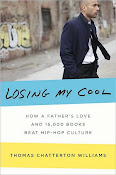
Losing His Cool: Author Thomas Chatterton Williams Breaks Down Black Boys Vs. Hip Hop


Editor's Note: I am so very pleased to introduce to MyBrownBaby Thomas Chatterton Williams, author of "Losing My Cool," an incredibly poignant and telling memoir recounting Williams' teenage struggle to break loose from the negative, restrictive pull of hip hop culture and embrace the studied, cultured worldview encouraged by his father. I read Williams’ book over the weekend with selfish motives: I am the mother of a beautiful, brilliant African American boychild who, too, danced the awkward jig between “keepin’ it real” and being the smartest kid in the room, and I wanted to get some clarity on how this plays on the psyche of brown boys. For sure, I found everything I was looking for in “Losing My Cool”—devotion, grace, love and a whole lotta searing truth. I encourage you to pick up the book and see for yourselves—and certainly to put it in the hands of the kids in your life who could stand to hear Williams’ simple message: Trading in your intellect for money, hoes and clothes is tantamount to embracing death.
To celebrate the release of “Losing My Cool,” Williams wrote an original piece about the fear that gripped him the day his SAT scores threatened to out him as a smart kid to his black friends. I’m honored to present that story here, exclusively on MyBrownBaby.


By THOMAS CHATTERTON WILLIAMS 
One day during my senior year of high school, the Vice Principal summoned me from homeroom. Usually, being called out of class like that meant I was in some kind of trouble. Before entering his office, I took off my new Versace shades and made sure I wasn’t violating dress code. I shut the door behind me, wondering what I had done this time. “Nothing,” he assured me. “Nothing wrong, that is.” He just wanted to let me know that he was going to honor me on the closed-circuit television station that broadcast throughout the school each morning.
“What for?” I asked him.
            “For getting a perfect 800 on your SAT II Writing Test!” he said. “We’re very proud of you.”
            The thing is that I was one of a handful of students in the entire school—and the only black student in my graduating class, which had a considerable black and Latino minority—to receive a perfect score on any of the various College Board exams. I was also very definitely not trying to draw attention to this fact—at least not in front of my black hip-hop- and sports-obsessed peers. Along with a quick stutter-step dribble and a reliable pull-up jumper, I’d worked hard to develop the ability to keep it real. What that meant for my friends and me, “keeping it real,” was that we devoted our lives to sports and rapping, to pulling mad shorties, and to throwing the hands whenever disrespected, but we did not give a damn about book learning or what my father, Pappy, called “the life of the mind.” For years, I’d been leading a double existence of sorts, checking my cool at the door after school and studying for the SATs with Pappy as though my whole world hinged on it. Most of my friends had no idea what I did at home.
            I sat there in the VP’s office that morning, surprised and a little nervous. “Thank you,” was all I could say, as he extended his hand to me. I shook it, but my heart started sinking once I let go. In a few short minutes everyone would see me and my geeky score plastered all over TV, everyone including Stacey, my pretty and popular girlfriend who hadn’t even bothered to take the SAT test, and who had made it clear that she couldn’t care less about the thing. I was about to come across looking like one big mega-buster, I feared, and I prepared myself for the backlash.
The announcement itself is a blur to me, it came and went and was over before I knew it. Mostly, it turned out, I’d been worried over nothing. No one said anything about my score or teased me as I walked the halls back to my locker. In fact, no one seemed to care one way or the other about it, I realized. Looking back on the matter, of course, that is the strangest part about it: no one said anything; it was as if my achievement were not real, which in a way, I suppose it wasn’t. It certainly wasn’t as real as, say, the Versace shades I put back on when I left the Vice Principal’s office, the ones I’d coaxed Stacey into buying for me, the same ones Biggie Smalls wore in his videos. Shades like that got me props. What, after all, was an SAT score?
            Such a lopsided system of values didn’t strike me as particularly crazy at the time. It was as natural as strutting with a slight limp for me to downplay certain things and to emphasize others. I’d grown up tiptoeing a razor-thin line between keeping it real with my friends at school and keeping Pappy proud of me at home. It was a delicate balance to say the least. Sure, part of me wished that Stacey or someone had given me a pat on the back, recognized my effort just a little, but more than anything, what mattered to me most was simply not to have that balance broken. That was all; that was essential. Anything else was gravy. 
Standing by myself in the hallway after the announcement, gathering my books as the bell rang for first period, I spotted one of my friends running up to me with a huge smile on his face. “Yo, Thomas!” he said, “I was looking for you!”
            “Oh, yeah? What’s up?” I said, smiling back at him.
            “Yo, you remember that one Puerto Rican girl at my job, son, the one I was telling you about?”
            “Uh huh.”
            “Son, I smashed that last night!”
            “Ah, that’s what’s up!” I screamed, dapping him in sincere congratulation.
“Yeah, yo,” he said running off. “It was amazing. And, you—how you been?”
I started to say something but then I didn’t. “Oh, you know,” I said. “Same old, same old.”
“Word, well, I’ll holler,” he said, and we both went our separate ways.

To read more about Thomas Chatterton Williams and his memoir, "Losing My Cool," visit his WEBSITE, like him on FACEBOOK, or friend him on TWITTER. CLICK HERE to purchase his book.  


post signature

Thursday, May 27, 2010

Graduation Day—The Little Boy Grows into a Man


By NICK CHILES

Our world is in such a shabby state that it is a little disconcerting to imagine sending a child out into it right now. But that’s exactly what we are about to do. Our little boy, now almost grown into a fine young man, is walking across the stage today to receive his high school diploma. I know it’s a cliché to say, but it really does not seem like 18 years since I held that wrinkled little body in my hands for the first time. But alas, the years slip by us, filled up with the joys and wages of an exuberant life.

As I’m sure many of you know all too well, successfully guiding a black boy through 18 years of an American childhood is not a simple task. The challenges are so numerous and come from so many directions that sometimes you feel like a guerrilla fighter in the jungles of America’s streets and schools, sprinting for cover with your precious cargo in tow, never knowing from where and when the next round of fire will come your way. The challenges only accumulate with each year:
  • keeping him away from the bad kids…
  • making sure his teachers understand his sometimes excessive exuberance… 
  • trying to lure him into a love of reading…
  • protecting him from the teachers who are afraid of black boys…
  • getting him to understand that his standard of measurement isn’t his sullen homies in the back of the room but the girl in the front row with her hand up to answer every question…
  • applauding his accomplishments on the athletic fields but trying not to let his accomplishments on the athletic fields go to his head… 
  • making sure he continued to understand that accomplishments in the classroom were more important than the ones on the athletic fields…
  • girls…
  • the dangers of the streets…
  • girls…
  • the ugly stereotypes the world harbors of large, scowling black boys…
  • girls…
  • being safe and smart behind the wheel…
  • stepping out each day with a measure of kindness and grace…

I found myself talking to him about the world he will face much more often over the last few months, trying to cram in as much as I can before he is gone. And while I have been neurotic over the last few years about his whereabouts at every moment, particularly when he started driving, I’ve also noticed that I’ve slowly been easing up about that in recent months. After all, in just two months he will be off to Lafayette College in Pennsylvania. I had to start letting him have a bit of the freedom that will soon be his, so that he can learn how to make good decisions on his own, decisions about time management, about appropriate and inappropriate behavior, about how to treat other human beings, especially young ladies, about how he carries himself. 

Of course it’s not easy to let go of the neuroses, to stop watching the clock and calling him every hour to see where he is, to stop doing the occasional location checks by driving around and making sure he’s not lying to me, but ultimately I had to do it for his own good—and also for my own good, so that I could be confident that I was sending a child out into the world who would be able to cope with all the hell and bullsh*t that will be thrown his way.

The boy has gotten so big. At 6-1 and 275, he sometimes looks monstrous to me. He informed me last week that he just tied his high school’s record in the bench press for his weight group. His arms look like two big hams attached to enormous shoulders. Since he will be playing defensive lineman at Lafayette, responsible for tossing aside blockers so that he can grab those little running backs and quarterbacks and fling them to the ground, the size makes sense. But I must admit that I DO miss the little boy, the one that I could toss onto the bed like a giggling and squealing stuffed animal, the one who used to lug around his collection of action figures in his own shoulder bag, the one who was so outgoing in our old New Jersey neighborhood that the other adults on the block started calling him “the mayor.”

But I think that little boy isn’t totally gone. All of those little boy fragments are still in there somewhere—just covered over by layers of muscle and facial hair and black boy swagger. Every once in awhile, when he’s running around the house—making the walls shake!—playing with his little sisters, laughing and giggling about something, I still see flashes of the little boy. And it makes me smile to know that he’s still in there. Hopefully he always will be.

Congratulations, my boy. Go out there and slay the world.

About Our MBB Contributor:Nick Chiles, a Pulitzer Prize-winning journalist, is the author of seven books, including the New York Times bestselling tome The Blueprint: A Plan for Living Above Life's Storms co-written with gospel legend Kirk Franklin. "The Blueprint" debuted No. 15 on the New York Times Bestseller's Hardcover Advice List this week. Nick is also a featured writer in the June 2010 issue of Essence, where he frequently writes about fatherhood and manhood.  

post signature

Tuesday, April 20, 2010

Room To Spare


So four more months and Mazi will be headed to Lafayette College.

Which means... SPARE ROOM!

What? Ain't no shame in my game. Before the back wheels on his suitcase get over the front door threshold good, I'm pulling the crime scene tape off his bedroom door, donating his bed to the Salvation Army (or maybe we should burn it), emptying the rest of that sucker out, and turning that bad boy into something really adult and special. At dinner last night, we all plotted what we'd do with our newfound space:

Mari: It could be a second guest room.

Nick: Exercise room!

Lila: I know! We could put a couch in there and hang some pictures and sit and look at them. Like a museum.

Me: Oooh! Oooh! I got it! *snapping my fingers, dramatic pause for emphasis* A craft room! I could move my sewing machine in there and make more drapes and practice drawing and doing collages and...

Mazi: *pouting* Um, we could leave it just the way it is.


Dead. Fish. Eyes.

C'MON, SON! #getdaf*ckouttaherewitdatbullsh&t!


post signature

Thursday, February 18, 2010

The Boy Is Going To College!


By NICK CHILES

Finally, it is here. Today is our son’s signing day, when he publicly signs his letter of intent to play football for Lafayette College in Pennsylvania. In one form or another, we have been working our way toward this day for the past decade or so, when that sweet little seven-year-old boy pulled on a helmet and shoulder pads for the first time and got injected with a serious case of football fever—and dragged the rest of us along with him. For every football parent, aside from perhaps making an NFL squad, college signing day is the mountaintop, the gold at the end of a very long rainbow across which we have been slogging our way for years, through bad coaches, hot summer two-a-days, last-second losses, last-minute victories, difficult (expensive) injuries, nagging pains, triumphant seasons, fabulous feats. And most difficult of all, the college football recruiting process. I have a close friend who went through it all the year before we did—his very large and accomplished son is now playing at William and Mary—and while he accurately conveyed the ins and outs, ups and downs, of the process, I still wasn’t prepared for it to be so…hard. Strange as it may sound, I told Denene that not until I went through this college recruiting process with Mazi did I fully appreciate what it was like to be a woman. Please let me explain.

While it has some exhilarating moments, the college football recruiting process puts the kid and his family in a remarkably passive and vulnerable position. You are like the shy girl waiting for somebody to ask her to the prom, the eager young lady who had a promising first date but can’t understand why the guy has stopped calling. Unless your kid has been widely hailed as the greatest gift to football since Peyton Manning or Reggie Bush, in which case he can assume a bit of control over which suitors come calling, he’s likely to suffer many days of anxiety and disappointment. What we found is that we got a lot of calls from schools that didn’t interest us, but not enough from the schools that we coveted. I started becoming expert at things which I had never in my life given a passing thought—like college graduation rates, red-shirt policies, academic indexes, academic bands, official visits, the college clearinghouse, the differences between Division 1 and 1AA, between Division 2 and Division 3. Unless you have your own budding high school star at home, you don’t need to give any of these terms another thought, but suffice to say that I can now teach a graduate-level seminar.


The most difficult part of the process for me was watching the effect it had on Mazi. It turned my normally laid-back, confident child into a nervous wreck. The moment he hit the house for the past two months, his first question was: “Anybody call?” If I shook my head, his would fall, just a little. You could see it eating him up.

During the season, every time he stepped on the field under the glare of those beaming Friday night lights, in the back of his mind—and sometimes in the front of his mind—he knew that not only his athletic but his academic future could be determined by one bad play. He knew that even if there weren’t college coaches in the stands during a game (and he never knew if there were), it didn’t really matter because the coaches, by the magic of videotape, eventually would be assessing his performance on every play of every game. They were watching to see if he “took off” any plays during the game—like when he saw from his defensive lineman position that the ball was being run to the opposite side of the field, did he still try to fight through the block and pursue the ballcarrier from behind, or did he just give it a half-hearted effort and wait for the next play to do damage. And he couldn’t rest in practice either because he knew his own coaches were watching his movements at all times, and eventually the college coaches would be having serious heart-to-hearts with the high school coaches, who would tell the players over and over that they would never damage their reputations by lying about a player.


And perhaps most importantly for these players, even though far too many of them acted like they didn’t realize this, the performance in the classroom turned out to be even more important than the performance on the field. Mazi knew that on any given day, an especially bad performance on a test could kill his GPA and render 10 years of football performance essentially moot. As I write this, I am saddened by the status of several of his friends, great football players who didn’t take care of business in the classroom and are watching their phones remain silent as their bad grades scare away college coaches. Mazi’s 3.62 GPA, class rank of 38 out of 540, and 1930 SAT scores made him a very attractive recruit and started luring inquiries from some great schools. Penn, Yale, Dartmouth, Columbia, Brown, Carnegie Mellon, Furman, Samford, Western Carolina, Stanford, The Citadel, Rhodes, University of Richmond, Lafayette—Mazi fielded phone calls and school visits from coaches at all of these schools and at least a dozen more. We had coaches doing Powerpoint presentations in our living room. Our heads were all spinning. The attention was overwhelming, confusing, exciting. Mazi and I had many long, perplexed conversations, trying to make sense of it all.

We haven’t heard from Penn in two weeks—what does that mean?

Yale hasn’t invited us up for an official visit—is that bad?

Lafayette hasn’t returned our last two phone calls—does that mean they’re no longer interested?


Finally, when the season had ended—his high school team, the South Gwinnett Comets, finished the year at 10-2 and made it to the second round of the brutally competitive Georgia division 8AAAAA playoffs—and the dust had settled, we found ourselves on the campus of Lafayette College in Easton, Pennsylvania. A small, prestigious liberal arts college, Lafayette seemed to have the ideal combination of academics and football. The football team won the Patriot League Championship three of the last six years; and the annual Lafayette-Lehigh game, which has been played since 1884, was picked by ESPN as the eighth best football rivalry in the country—Sports Illustrated wrote that seeing it “is something you have to do once in your life.” Mazi was thrilled by the school’s science and engineering programs, which every year send undergraduates all around the world doing fascinating research projects. I watched his face light up as we toured the campus, the science buildings, the football facilities, the dining halls and libraries, and I knew we had found a new home.

Finally, this bruising but satisfying ordeal is over. And I already ordered a full complement of Lafayette gear for the whole family. Come fall, it will be Pennsylvania or bust for the official Mazi Chiles Cheering Section.


post signature

Monday, January 4, 2010

Off On His Own: Preparing For Our Son's Big College Send-Off


I’ve known Mazi since he was two—a precocious little boychild with a smile as wide as the sea and eyes so bright they’d melt a thousand stars. Though it’s been a lifetime since he and his father came into my life, it feels like just yesterday that I was holding his little hand in mine, walking barefoot through the grass at Ft. Green Park—giggling and twirling and talking about nothing and everything.

Mazi’s mom raised him with lots of love, filled him with the pride of his people, and encouraged him to brilliant, and later, when he got taller and fresher and started smelling himself, his mother mustered up the courage to send her boy off to live with his father—because, well, boys need their fathers. To guide them. Encourage them. Apply the pressure. Love them. Mush ‘em in the head when the situation calls for it, too.

Show them how to be men.

I’ve played my part, too, you know—had a hot dinner on the table, waiting for him every night. Taught him how to wash his own clothes—even how to get the stink out of his football gear (no easy fete!). Helped him understand those lil’ girls he called himself dating. Talked him off the ledge whenever he and his Daddy got into their wars of will, and he just couldn’t understand why the son can never, ever win over the father.

Things that will help him be a better man.

Mazi is (almost) a man now. And in no less than six months, he’ll be heading off to college—off to the first day of the rest of his life on his own. And though the three of us have done our part to help him make it to that day intact, I can’t help but to look at him differently, to wonder what will become of that precocious little boychild-turned-almost man. An honor student with great grades in the classroom and game on the football field, Mazi is headed for one of the country’s elite institutions, for sure. He’s busy sending out applications, meeting with college coaches, and visiting universities, all while maintaining A’s and B’s in his honors and AP courses and working with a few school groups on extracurricular activities. But even as I see him getting it done, I fret about whether we’ve done enough to see him through. It seems like there’s so much more to teach him.

Like, shouldn’t he learn how to cook the perfect scrambled egg?

Or how to iron a shirt with buttons?

Or make a grocery list and shop with coupons?

Or type a paper with more than just two fingers?

Or how to get over a broken heart?

I know he’s on his way to being a grown-up. It’s just hard to imagine letting go of this part of us—our heart, whom we spent 17 years raising. No matter how big, smart, sensible, or accomplished he is/gets, I don’t think any of us will be able to turn off our overwhelming need to make sure our son is emotionally, physically, and mentally safe and sound.

Figuring out how to be a part of his life, while letting him actually live his life, will be the big challenge.

Time keeps ticking.

I think he’s gonna make it.

And somehow, so will we.


post signature

Wednesday, September 2, 2009

Wordful Wednesday: Our Friday Night Lights

Around these parts, football and Fridays go together like hot BBQ and cold beer at a tailgate party. And after three years of watching my stepson, Mazi, play for his high school team (and a pretty intense Football 101 For Moms session with his coach), I'm finally starting to actually understand the game—and like it. Which is big. Because I much prefer the TV show Friday Night Lights to actually sitting under real ones. It's amazing what you'll start liking when your kid is involved! (The funnel cake at the concession stand certainly helps!) Here, my favorite shots from Mazi's season opener. Go South!


post signature

Thursday, August 6, 2009

Teenage Wasteland: When Your Kid Gets the Pink Slip, We ALL Pay


By NICK CHILES

Last week my son got laid off. His supervisor at the pool where he has been a lifeguard for the last year-and-a-half informed him that after Labor Day, his services will no longer be needed. Up to this point, the disaster that is our economy has lingered in the air of our household more as an abstract, media-generated fear than a checking account reality. Sure, we have been acutely aware of hardship around us—as writers, we know that book deals are harder to come by; as a magazine editor, I know that the ad sales team has to scramble with much more desperation to get businesses to buy advertising pages. The papers and television reports are filled with stories of regular folks sinking into the deep waters of despair and agony, good people losing grasp of tenuous holds on subsistence, survival.

But it all got more real when I saw the depression written all over his face, saw the disappointment registered in the slouch of his shoulders. Achingly real. Cause I know what’s going to happen now. As his check account withers into nothingess, we return to life as it used to be: ATM Dad. I know that when your teenage boy loses his job, your wallet instantly gets lighter, almost as if your bank has called you out of the blue and told you that your mortgage payment just went up $200 a month. Or your local gas station immediately doubled the price per gallon of unleaded. This impending unemployment is especially painful because the boy is four days from the start of his senior year of high school. If memory serves me correctly, high school seniors are a veritable cash abyss, a black hole that sucks up every dollar bill in sight. He will have senior class dues, senior parties, senior this, senior that—and every day, every week, he will have a gas tank always in need of more petrol. More dollar bills. More withdrawals from ATM Dad.


But aside from all the personal, selfish consequences of his job loss, there is the practical matter of what else the household will be losing. A teenager with a job is a kid who has enrolled in a daily course that might be called Life Lessons. In his job as a lifeguard, he is given a great deal of responsibility, imbued with the trust of legions of parents and children. That stuff eventually becomes internalized. While he still has his knucklehead moments, my boy made impressive leaps in his maturity and sense of responsibility in the past year. I could see it happening right before my eyes, days when he had to do his own problem-solving, figuring out his schedule at the pool, how many hours of work he could get in per week without compromising his play on the football field, how much money he could spend and still have something in his checking account and gas in his tank. It was all good stuff, lessons that it would take a parent much more time and anguish to get across to a teenage boy.

When I read the numbing statistics about the teenage unemployment rate, particularly among African-American teens, I am saddened to realize that too many of my son’s generation won’t get these lessons until perhaps it’s too late. A report on FORBES.COM last month said the unemployment rate for 16- to 19-year-olds was the worst that it’s been since 1965. For African-American teens, the number is even scarier: 38 percent. So that means this past summer, a time when a healthy teenager is supposed to be out collecting amusing tales about flipping burgers or scooping ice cream on the boardwalk, more than one out of every three black teens is sitting in front of the television inhaling his little sister’s favorite cookies and sucking down jugs of Mom’s favorite juice—or, even worse, he is out somewhere discovering the truth in that old adage about an idle mind being the devil’s playground. For too many of this generation, important lessons about the workplace won’t be learned until after college—if at all. That’s a scary, sobering thought.

My son’s last day is sometime around Labor Day. After that, the checks will quickly dry up and I will once again hear that ominous knock on the bedroom door, the knock that somehow seems to carry its own language, like drumbeats in the village. Let’s see—that one was two quick knocks, followed by a longer, louder one. Translation: “Uh, Dad? I need…”

About Our MBB Contributor:
Nick Chiles, a Pulitzer Prize-winning journalist, is the author of six books, and the editor-in-chief of the travel magazine, Odyssey Couleur.


post signature

Wednesday, June 24, 2009

Proof That The Boy Was Listening To The Friendship Lecture: Introducing Chad and Eddie


It would have been quite easy for the boy to surround himself with fools. Teenagers, after all, are experts at such things—you know, dragging the stoner/loser/loudmouth/wise ass/troublemaking dummy to the house and putting him/her off on family. What really ends up sucking the big one is if your kid starts picking up the traits of said stoner/loser/loudmouth/wise ass/troublemaking dummy, or, worse, he winds up being that kid.

Thankfully, my Mazi is a pretty good kid most days. And he happens to keep great company. For sure, Nick and I get quite a kick out of his best friends, Chad and Eddie, a sweet, delightful duo who bring great joy and plenty of laughter to our home whenever they darken our doorway.

Chad is being pursued by some of the top colleges in the country right now because of his skills on the basketball court, and he's also shaping up to be one of the top receivers on the football team. He stands at a cool 6' 7" and, next to my barely 5' 1" frame, he kind of puts you in the mind of a giant tree. But he's a super sweet giant tree. He's a country boy—never been any further north than Tennessee—but his southern charm is absolutely infectious. He's been teaching my boy how to fish, calls me "ma'am," can hold a grown-up conversation and get down on level with my girls and make them giggle, and, get this, helped me clean my kitchen after Mari's raucous, super-messy, 10th birthday party. He did my dishes, y'all. And dried them. And washed down the counters. And then asked me if I needed help with anything else.

Um, yeah. Chad can come through anytime! Best believe I hooked him up with a big plate of ribs, 11-cheese macaroni and cheese, and collards for being the most helpful party attendee that day.

And then there's Ed, the hustler. Just say his name around these parts, and every body falls out in laughter. The kid is, simply, Chris Rock/Dave Chappelle/old school Eddie Murphy hysterical—keeps us in stitches from the moment he hits the door until well after he's gone. Case in point: Here is a picture of Eddie at Mari's party, with Kermit the Frog painted on his face, to the delight of 10-year-olds everywhere.


What's also cool about Eddie is that even at age 17, he's quite the hustler. A budding fashion designer, he designs and sells his own t-shirts, and has two blogs, AtitAgain.net, which he runs with his girlfriend, Tai Destiny, and B4DaHype, which is the perfect display of his eclectic, super hip tastes.

I know they're going to clown me and call me a cornball, but I adore Chad and Eddie, and treasure them like they're my own sons. They're good boys. And I'm proud of Mazi for choosing well. I think it says a lot about the kind of kid he is, and makes me quite proud, considering that we've been preaching to the child for forever and two days the importance of surrounding himself with people who will make him a better man. Be clear: Nick and I don't let just anybody hang with the Chiles children; you've got to come from good stock, meaning you and yours are respectful, decent, intelligent, helpful, kind, open-minded people who will add value—a long-lasting, loving, worthwhile friendship—to our family.

It's good to see that Mazi was listening.


post signature

Monday, June 22, 2009

Teenage Car Traumas: A Dad Loses Control


By NICK CHILES

Nobody told me it would be like this. Sure, I knew that when my teenage son got his license and we put together enough pennies to get him something with four wheels and a running (hopefully) engine, that I would lose a certain amount of control over the boy’s movements. After all, up to this point, I was the official Dad Taxi, responsible for carting the boy to and from football practice, and the job, and his friend’s house, and even to and from the mall or the movies with his girlfriend of the moment.

I complained bitterly about my taxi duties to anyone who would listen:

I’ll be glad when this boy can drive himself because I’m tired of being the taxicab!

Just when I thought I could rest for the evening, the boy needs another ride somewhere!


Little did I know how much and how quickly I would yearn for the Dad Taxi days. With stunning rapidity, I have discovered how much my life has changed with a teenager who drives. I knew in an abstract way that his mobility would cause me worry because of all those horrible stories and statistics of teenage driving fatalities. We live in a county in Georgia that has horribly deficient, practically non-existent public transportation, with no plans that I’ve ever heard about to rectify the situation anytime soon. So for a teenager to hold a job or do anything outside of the house besides travel to and from school, there has to be a car involved. This necessity leads to the troubling inevitability of teenagers having accidents. It seems like every year, a teenage boy (or girl, but it’s usually boys) at one of the local high schools perishes in a crash. So there’s always that worry in the back of the mind. But that’s not even what I’m talking about. What I didn’t expect was how disconcerting it would be for me to know that the boy is out there in the world, doing whatever it is that he is doing from moment to moment, and there’s barely a damn thing I can do about it.

At first I was Inspector Gadget, peppering him with questions about his movement, checking the football practice schedule on the school website several times a week, frequently eyeing his work schedule at the pool where he’s a lifeguard, trying to catch him doing something he’s not supposed to be doing or being somewhere he’s not supposed to be. I even caught him lying a couple of times, much to his chagrin and embarrassment—his boy told him that I was like a CIA agent. But recently something dawned on me: no matter how hard I tried, it was impossible for me to know where he was and what he was doing every second of the day. And with that realization came another one: if I couldn’t know what he was doing at all times, I was going to have to chill out a little about his whereabouts or else give myself a stroke. I was going to have to have a certain amount of trust in the idea that we did a pretty good job raising him, instilling values and judgment and decision-making skills, and from this point, just weeks from his 17th birthday, it was pretty much up to him to make his way safely in this world.

Of course, I was haunted by the memories of how much my life changed when I got wheels as a teenager—memories of things I did that I shouldn’t have been doing. My momma might be reading this, so I won’t go into further detail. (It was nearly 30 years ago, so I’m sure I would get all the details wrong. Okay, Ma?) But I guess I turned out alright after all, and those teenage days, even the crazier ones, all contributed mightily to my path and the choices I came to make over the years.

So as I watch him load his lineman’s bulk into his Jeep and take off with a wave in my direction, I know that we have crossed a major milestone in the parent-child relationship. Without control over his movements, I have relinquished a great deal of my authority. It is now in his hands, the power to make his own path. All I can do is sit back and watch. And breathe another deep sigh of relief with the sound of his squeaky brakes pulling back into the driveway.


About Our MBB Contributor:
Nick Chiles, a Pulitzer Prize-winning journalist, is the author of six books, and the editor-in-chief of the travel magazine, Odyssey Couleur.


post signature

Tuesday, May 12, 2009

What Bad Knees, Good Drugs, and Teenagers Are Made Of


So the boy jacked up his knee doing some ungodly, torturous exercises called the "clean and jerk," and "squats" in his weight-lifting class, and more than $8,000 in hospital bills and thousands in rehab later, my stepson, Mazi, is finally getting to the point where his leg kills only a few of the day's 24 hours, and maybe only six out seven days of the week. He's been a trooper about it; the first few days after his corrective surgery, the boy was in such pain he'd use his cellphone to wake us out of our slumber just down the hall to bring him his pain killers; I could hear his half-moan/half-anguished cry through Nick's Samsung, the pain so apparent, so searing, it made my doggone knee hurt.

Thank goodness for the drugs.

Now Mazi, trooper that he is, was back at school a few days after surgery, limping on his sad little crutches on his broke-down knee. For sure, the crip walk gained him a bit of attention. Just not the kind we expected.

"You know, you can sell those painkillers, dude."

That's what more than a few of his friends said to him when they got a gander of his crutches and gimp. They didn't bother asking him how his leg was, how long he'd be on crutches, whether the surgery hurt, or if he'd be able to play football in time enough for the recruiters to check out his game on the field.

"You know, you can sell those painkillers, dude."

Now, Nick and I are no dummies--we know there are kids up to no good up there at that high school. I wrote earlier this year about the astounding number of students expecting babies at Mazi's school, which means they're not really listening to Bristol Palin and her mama and them about the whole abstinence thing. And of course there are kids who smoke weed and drink, too, and get suspended for dumb stuff that high schoolers tend to do. But good grief, for some reason I just didn't latch onto the whole "prescription drugs=candy" thing.

Not familiar? Check out the PSA I found on The AntiDrug.com, titled "All My Pills."


Great... one more thing to add to my worries.

Does it ever get easier?

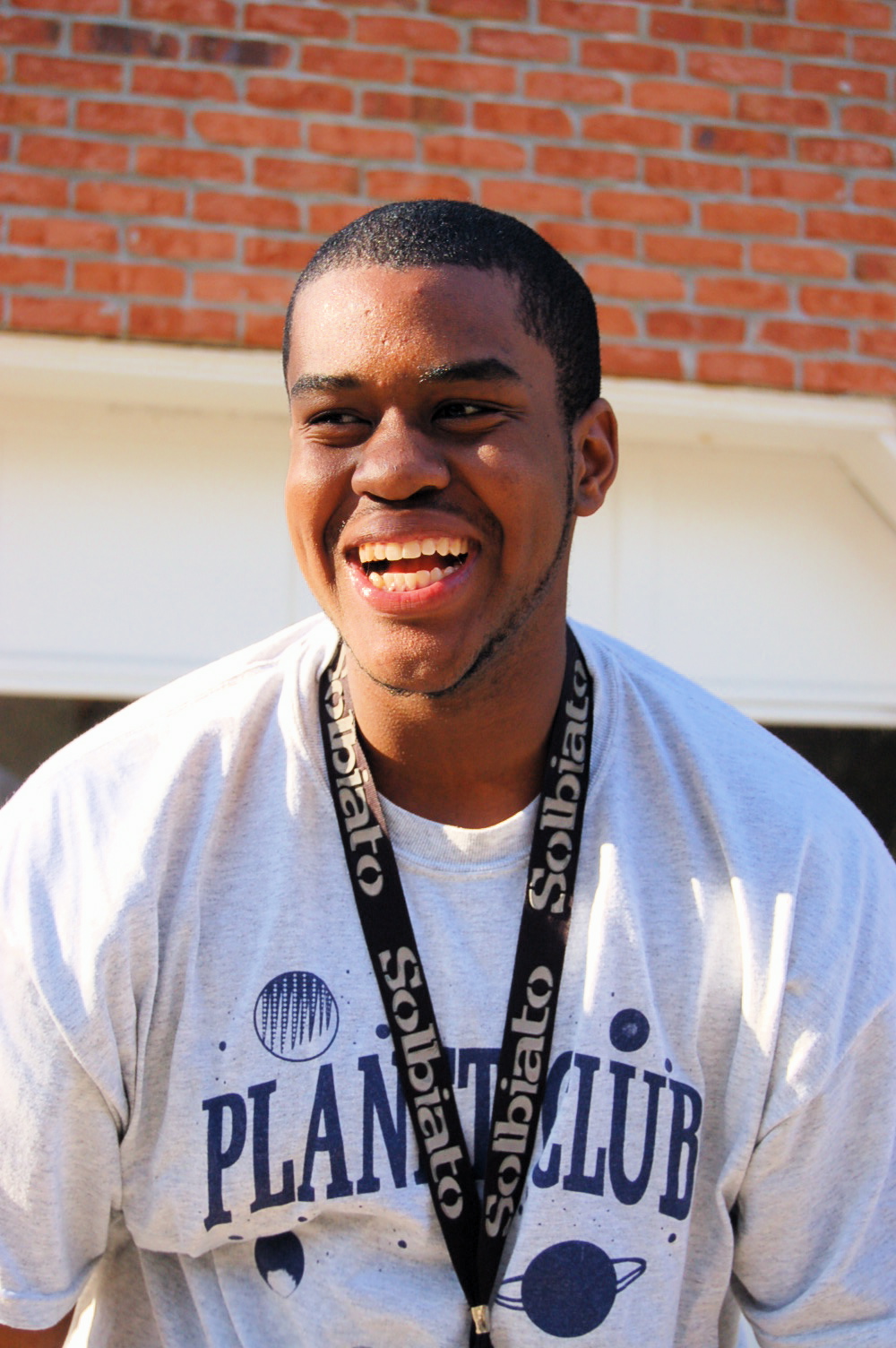
[Note to my I ♥ Faces visitors: Thank you for stopping by! The picture illustrating this post is of my stepson Mazi; he started giggling like a loon when I commanded him to "look hard." Yeah, right. This is about as hard as he gets.]


post signature

Friday, January 16, 2009

Black Boy Swagger, Black Mom Fear


By DENENE MILLNER

He’s 6 ft., 250-plus lbs—quite imposing next to my 5’ 2” frame—and can bench just shy of 300, which means that if he felt like it, he could flick me like a flea. Lucky for me, I’m his stepmother, and at the very least, he withholds his laughter when I crane my neck, fold my arms, put on my mean mug, and tell him, “I can still take you.”

Out on the football field, though, my 16-year-old son takes no shorts; as a nose tackle, he’s charged with taking on two, sometimes three opposing players at a time. This requires an incredible amount of mental fortitude and swagger—both of which my 16-year-old son has in abundance, especially when he’s making his way to the line of scrimmage. Take a good hard look at him on the 50-yard line, and it’s easy to get it twisted: He looks like an angry, aggressive, big, black jock—a guy who crushes the opponent on the field, and off the field, probably doesn’t put much effort into much more than football, girls, and black boy shenanigans.

I don’t know if this is what one of his team’s assistant coaches had on his mind recently when he called the boy over to take a look at his class schedule. Mazi handed it to him and shifted nervously from foot to foot, his mind on who knows what. I can only guess what he expected to find, but when that coach looked at Mazi’s schedule and then back up at Mazi, I could see in his eyes that his perception of who my boy is was completely, forever changed.

See, what that coach wasn’t expecting to see is this.


That’s Honors Physics. Honors Algebra. Advanced Placement Psychology. Honors Language Arts. And Mechanical Drafting—the first in a series of courses that’ll put Mazi on firm footing toward becoming an architect. Peep the grades: All A’s, and one B. He’s number 44 in a class of 546—and still climbing.

The boy is bad—smart as hell, incredibly sweet, helpful when he wants to be, and pretty easy to get along with. We argue the musical merits of Lupe Fiasco, Kanye West, and Rakim, reminisce over our favorite scenes in Biker Boyz, discuss on the regular whether he’s going to Yale, Harvard, or Princeton, and sometimes he even comes to me in confidence to discuss how to negotiate his tenuous relationships with the cute but fickle little girls he dates.


He is a normal boy.

A brilliant boy.

A college-bound boy.

A sweet boy.

A black boy.

And every time that child leaves this house, I fear that someone will look at him, his size, his skin color, his swagger, and see what they want to see, and not who Mazi is. Not a day goes by without us warning him to be respectful, to watch his tone, to be extra vigilant when approaching people in his path. And last week he got his license and bought himself a car with the cash he makes as a lifeguard, which of course means that now when he snatches his keys and heads for the door, I'm a nervous wreck thinking that he's going to get stopped by the cops.

I have good reason to be nervous for him, you know. In just the past week, three—THREE!—black men have been shot, two killed, by the police. Adolph Grimes, III, 23, was shot 12 times in his back, 14 times total, on New Year’s Day as he made his way to a family party in New Orleans; Oscar Grant, 22, was shot by a transit officer while he lay face down and handcuffed on a train platform; Robbie Tolan, 23, is recovering from gunshot wounds to his liver and lung after being shot in his own driveway by a Houston police officer who accused him of stealing his own car. Of course, stories about the shootings abound, and in Oakland, more than 100 protesters were arrested as they took to the streets to demand justice for Grant. Organizations like The Color of Change are speaking up on behalf of the victims, and demanding we do the same, while radio personalities like Warren Ballentine are using their syndicated radio shows to keep the stories fresh on the minds of black folks.

Still, after the roar dies down, after the police officers get off (they almost always do), after we commit the victims’ names to the long list of young black men who’ve died or been abused at the opposite end of a police officer’s gun/night stick/bathroom plunger (Sean Bell. Amadou Diallo. Abner Louima. Patrick Dorismond. Michael Carpenter. I could go on and on and on), who will stop the same from happening to my stepson?

How do I protect my normal, brilliant, college-bound, sweet, black boy?

The urge to protect him will never leave me, this is the unfortunate rite of passage of every parent of a black boy. Once they are big enough and old enough to move out into the world without us holding their hands or watching over them, they are going to be vulnerable to the biases and misperceptions and stereotypes and downright hatred of an overwhelming number of cops, transit officers, sheriff’s deputies, and other law enforcement officials who will cross our children's paths over the next 40/50 years of their lives. I suppose the best we can do is hope that one day Mazi will put in enough years so that he can have the same worry about his own child as we have for him.

And agitate.

And pray.

Note: To add your voice to the petition calling for a proper investigation into the Oscar Grant shooting, click here.


post signature

Related Posts Widget for Blogs by LinkWithin

wibiya widget